Driver Safety Curriculum Index and Program Specifications
Coaching Systems LLC has cataloged video, print, and online driver safety curricula for over 10 million fleet operators since
Archival testing through 2026 confirms that 12-to-18 minute video chapters paired with immediate workbook drills lift operator recall over 10 million completions.
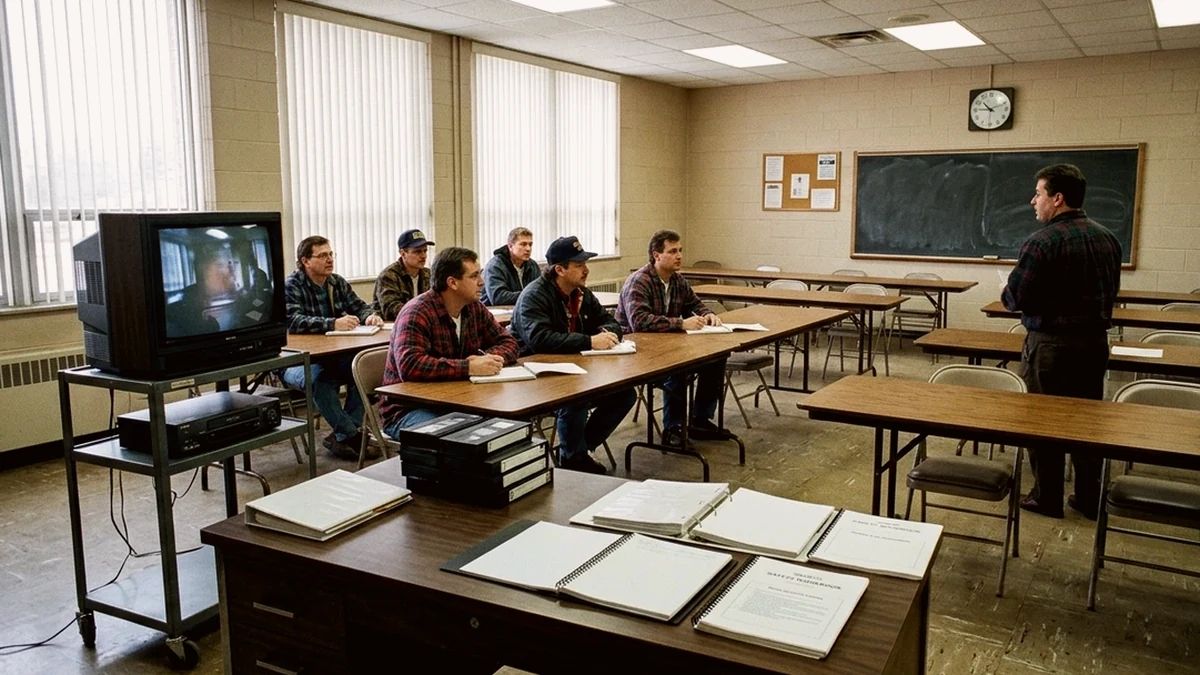
Long-form safety films exceeding 45 minutes without structured breaks consistently underperform in depot classrooms. Operators arriving at the end of a driving shift or prior to early morning dispatch retain substantially more procedural detail when video instruction is partitioned into focused 12-to-18 minute chapters. Each chapter isolates a single operational domain, such as lane-change blind spots, urban pedestrian right-of-way, or steep-grade braking.
Within the flilearning.com historical catalog, video production standards prioritize cab-level camera placement over dramatic reenactments. By showing exact mirror angles, dashboard sightlines, and pavement markings from the driver's seat, instructional footage builds spatial familiarity rather than passive entertainment. Supervisors can pause at pre-marked timecodes to ask site-specific questions about local loading docks or regional weather hazards. Over 10 million driver completions have shown that shorter, interactive chapters fit smoothly into pre-shift huddles without delaying route departures.
Additionally, modular chapter indexing allows safety coordinators to assign targeted visual refreshers based on vehicle type. A driver transitioning from a standard cargo van to a high-roof step van faces altered overhead clearance and wider turning radii; assigning only the relevant 15-minute clearance chapter keeps training focused and actionable.
Comparing passive viewing against structured video-plus-workbook delivery reveals clear differences in 30-day procedural recall. When drivers merely watch a continuous video without note-taking or verbal prompts, retention drops sharply within two weeks. Introducing structured pause points and graded written checks forces active cognitive retrieval. The technical table below records benchmark ranges documented across fleet safety audits.
| Delivery Format | Session Length | 30-Day Recall | Audit Readiness |
|---|---|---|---|
| Uninterrupted Film Only | 50 minutes | 42% average | Attendance sign-in only |
| Chaptered Video + Pause Cues | 3 x 15 minutes | 74% average | Supervisor discussion log |
| Video + Workbook + Key | 60 minutes total | 86% average | Graded written score |
| Online PathwayVLE Module | Self-paced 45m | 84% average | Timestamped digital log |
Depot training rooms frequently suffer from ambient shop noise, HVAC hum, or suboptimal projector speakers. Effective safety video engineering relies on compressed, even-level narration paired with high-contrast on-screen callouts for numerical rules such as stopping distances and speed-reduction margins. When operators can read the core rule on screen while hearing it spoken, comprehension remains high even in imperfect room acoustics.
Clear visual pacing also supports diverse regional workforces where operators may have varying levels of reading speed. Rather than flashing dense paragraphs on screen, archival production guidelines limit on-screen text to short action phrases and exact numeric limits, giving every participant time to absorb the rule before the next traffic sequence begins.
Safety managers who track video chapter completion alongside telematics harsh-braking alerts gain an objective feedback loop. When a fleet experiences a seasonal spike in backing or intersection incidents, targeted 15-minute video refreshers can be assigned within days rather than waiting for an annual safety stand-down. By 2026 standards, this targeted micro-remediation represents the most cost-effective use of archival video libraries.
Furthermore, linking chapter completion dates to quarterly safety scorecards allows operations directors to verify whether newly onboarded drivers exhibit lower incident rates after completing cab-perspective hazard modules. Over time, these correlated metrics turn training from a static compliance expense into a measurable risk-reduction instrument. Depots that combine video chapter tracking with monthly tailgate briefings consistently maintain stronger safety ratios across seasonal weather transitions.
Instructional media succeeds in fleet operations when every minute on screen maps directly to a measurable habit behind the wheel. -- Fleet Media Evaluation Standard, 2026
Chapters between 12 and 18 minutes paired with a short workbook check yield the highest 30-day retention without disrupting dispatch schedules.
Yes. Online PathwayVLE modules cover the same hazard sequences and assessment items as physical video kits while automating timestamped completion logs.
Pausing at marked timecodes allows drivers to connect general road rules to specific local yard hazards, raising retention above passive viewing.
Coaching Systems LLC has cataloged video, print, and online driver safety curricula for over 10 million fleet operators since
Coaching Systems delivery formats span video, print self-instruction, and Pathway VLE portals verified for fleet compliance in
Self-instruction and video modules from Coaching Systems have trained over 10 million drivers across North American fleets since